
Inland Empire commercial real estate loans fund the warehouses, apartment communities, retail centers, and development sites that anchor the most active industrial market in the United States. For borrowers across Riverside and San Bernardino Counties, the challenge is rarely whether capital exists — it is reaching the right lender, on the right structure, at the right point in the rate cycle. Financial Compound is an independent, borrower-side commercial mortgage broker that has placed more than $6 billion in debt and equity since 1996. This guide walks through the financing and refinancing options available to Inland Empire commercial property owners in 2026, the benchmarks that drive pricing, and what it takes to qualify.
What Inland Empire Commercial Real Estate Loans Cover
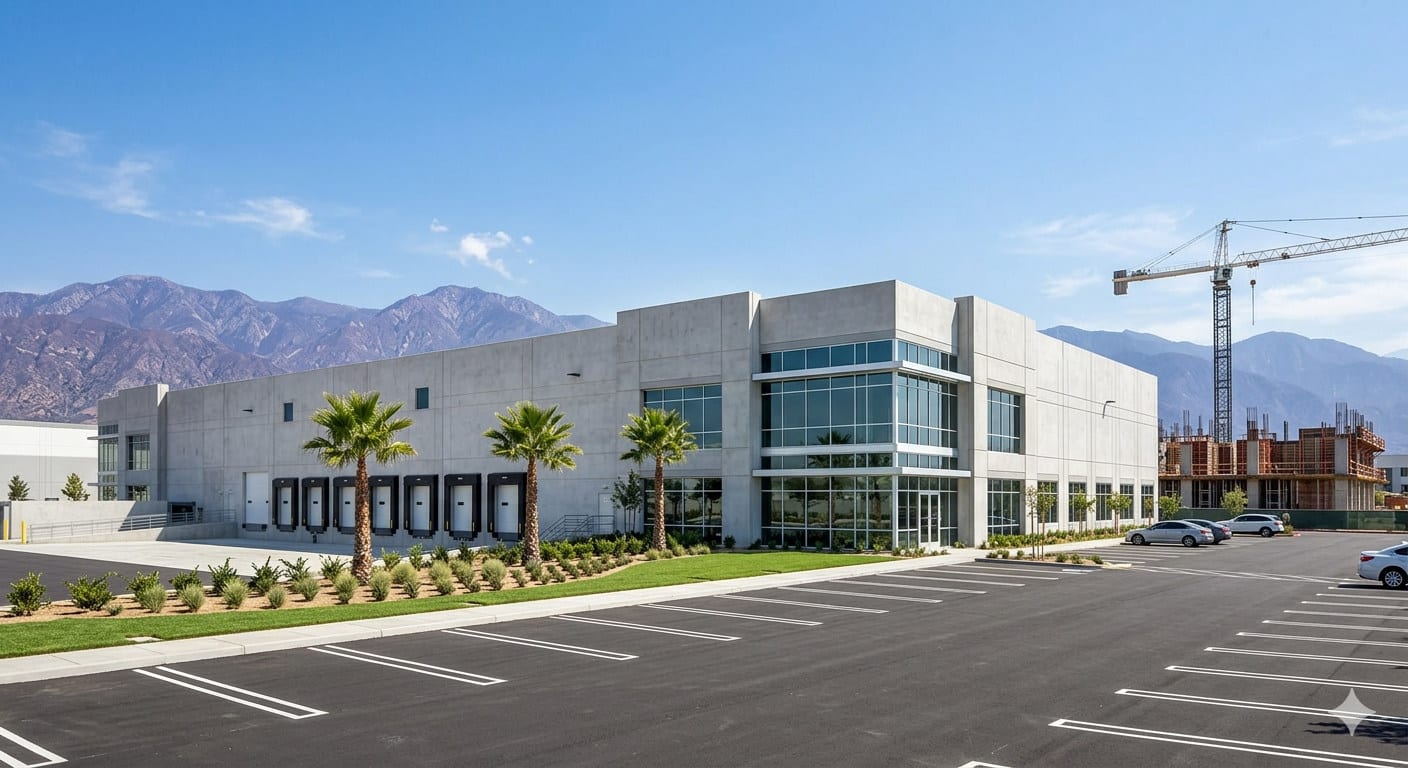
Inland Empire commercial real estate loans extend to nearly every income-producing asset class in the region: industrial, logistics, warehouse, and distribution facilities; multifamily and mixed-use buildings; retail and grocery-anchored centers; office and medical office; self-storage; entitled and unentitled land; and ground-up development. The region’s gravity is industrial. Riverside and San Bernardino Counties hold an estimated 4,000 warehouses and more than two billion square feet of distribution space within a 50-mile radius of Ontario International Airport — the largest contiguous industrial concentration in the country. Proximity to the Ports of Los Angeles and Long Beach, the I-10, I-15, I-210, and I-215 corridors, and rents well below Los Angeles and Orange County keep capital flowing into the market. Heading into 2026, the industrial market is stabilizing after a period of correction — vacancy around 7.2% and availability near 11.9% as recent completions are absorbed — with leasing volumes rising across asset classes. Each submarket — the Ontario, Rancho Cucamonga, and Fontana logistics core; the Moreno Valley and Perris distribution corridor; Riverside and San Bernardino infill; and the Corona and Eastvale belt — prices differently, and the loan should reflect that.
The 2026 Rate Environment for Inland Empire Borrowers
Pricing on Inland Empire commercial real estate loans tracks a handful of national benchmarks. As of mid-June 2026, SOFR is near 3.69%, the 10-year Treasury hovers around 4.45%, the Wall Street Journal prime rate is 6.75%, and the federal funds target range is 3.50% to 3.75%. The Federal Open Market Committee meets June 16–17, and borrowers are watching for any signal on whether the pause continues or rate cuts resume. For commercial real estate, the practical effect is that the floating-versus-fixed decision is live on nearly every transaction. In large-format industrial — where basis and proceeds drive returns — the debt structure can matter as much as the purchase price.
How SOFR, Treasury, and Prime Shape Your Loan
SOFR is the index beneath most floating-rate commercial debt; a bridge or construction loan is typically quoted as SOFR plus a spread, so the all-in rate moves with the benchmark. The 10-year Treasury anchors fixed-rate, permanent debt — CMBS, life company, and bank loans — at a spread over the corresponding Treasury. The prime rate governs much of SBA and small-balance bank lending. Knowing which benchmark drives your loan tells you where the risk sits: a SOFR-indexed facility exposes you to short-term rate moves, while a Treasury-based fixed rate locks your cost for the term.
Fixed vs. Floating: The 2026 Decision
With SOFR near 3.69% and the 10-year Treasury around 4.45%, the gap between short-term and long-term money is narrow by historical standards. Floating-rate debt can be priced attractively today and benefits if the Fed resumes cutting, but it leaves you exposed if rates hold or move higher. A fixed rate costs a premium for certainty yet protects a long hold. The right answer turns on your hold period, business plan, and tolerance for rate risk — exactly the trade-off a competitive process is built to quantify before you commit.
Financing Options for Inland Empire Commercial Property
A competitive process across multiple capital sources — institutional and private equity, life insurance companies, money-center and regional banks, CMBS conduits, credit unions, debt funds, and private capital — is what separates a market term sheet from the best available execution. The right program depends on asset type, business plan, and hold period.
The table below maps common Inland Empire asset types to the capital sources and leverage borrowers typically see. Actual terms vary with sponsor strength, the rent roll, and the asset’s position in its business plan.
| Asset type | Typical capital sources | Typical leverage |
|---|---|---|
| Industrial & logistics | Banks, life companies, CMBS, debt funds | 60–75% LTV |
| Multifamily | Fannie DUS, Freddie Optigo, HUD/FHA, banks | 70–80% LTV |
| Retail & mixed-use | Banks, CMBS, debt funds | 60–70% LTV |
| Owner-occupied | SBA 504 / SBA 7(a) lenders, banks | Up to 90% LTC |
| Construction & land | Banks, debt funds, private capital | Up to 95% of all-in cost |
| Bridge / transitional | Debt funds, private capital | 65–75% LTV |
Industrial & Logistics Loans
Acquisition, refinance, and permanent debt for bulk distribution, fulfillment, cold storage, and cross-dock facilities, underwritten against DSCR, LTV, debt yield, and NOI benchmarks appropriate to large-format industrial. With the Inland Empire capturing 14 of the nation’s 100 largest industrial leases in 2025, lenders compete hard for quality product here.
Multifamily & Apartment Loans
Fannie Mae DUS, Freddie Mac Optigo, HUD/FHA, and bank balance-sheet execution serve the region’s fast-growing residential base. Agency debt offers long amortizations and non-recourse terms for stabilized apartment assets, while bank loans can move faster on value-add and lease-up deals.
Retail & Mixed-Use
Grocery-anchored centers, neighborhood retail, and mixed-use projects along the Corona and Eastvale commuter belt draw bank, CMBS, and debt-fund capital. Tenant credit, lease rollover, and sales per square foot drive both proceeds and pricing.
SBA 504 & SBA 7(a) for Owner-Users
Owner-occupied financing for Inland Empire operating businesses offers longer amortization terms, competitive fixed rates, and lower down payments than conventional debt. SBA 504 suits real estate and heavy equipment; SBA 7(a) covers broader business purposes. With a prime at 6.75%, the SBA 7(a) variable structure remains workable for many owner-users.
Construction & Land Loans
Ground-up and major-rehab construction debt for Class A industrial and mixed-use projects, plus acquisition and predevelopment capital for entitled, semi-entitled, and unentitled land, with structures reaching up to 95% of all-in cost for qualified sponsors assembling development sites along the I-15 and I-215 growth corridors.
Bridge & Hard Money
When timing or transitional risk rules out conventional debt, SOFR-indexed bridge facilities and private hard-money loans provide speed. Financial Compound has closed hard-money loans in as little as two business days and land loans in five.
Refinancing Commercial Property in the Inland Empire
Refinancing is where many 2026 conversations begin. Loans underwritten in the low-rate years are maturing into a higher-rate market, and owners need a plan well before the balloon date.
Why 2026 Is a Pivotal Refinancing Year
An estimated $1.8 trillion in commercial real estate debt is maturing across the United States through 2026 — the so-called wall of maturities. Many Inland Empire owners financed or refinanced at materially lower rates, and those loans now require refinancing, extension, or recapitalization at today’s benchmarks. Starting early gives you room to run a competitive process rather than accepting whatever the incumbent lender offers under deadline pressure.
Rate-and-Term, Cash-Out, and Recapitalization
A rate-and-term refinance replaces an existing loan to reset the rate, extend the term, or switch between floating and fixed rates. A cash-out refinance pulls accumulated equity out for reinvestment or business needs, subject to LTV and debt-yield limits. A recapitalization restructures the entire capital stack — senior debt, mezzanine, and equity — and is common on transitional or partially stabilized assets. Each path is weighed on a true cost-of-capital basis, accounting for prepayment penalties such as yield maintenance and defeasance on the existing loan.
How to Qualify for Inland Empire Commercial Real Estate Loans
Commercial underwriting centers on the property’s income, not just the borrower’s credit. Lenders evaluate the asset, the sponsor, and the market together.
DSCR, LTV, and Debt Yield
Debt service coverage ratio (DSCR) measures net operating income against annual debt service; most lenders want 1.20x to 1.35x or higher. Loan-to-value (LTV) typically tops out between 65% and 75% for permanent debt, and higher for SBA and certain agency programs. Debt yield — NOI divided by loan amount — gives lenders a leverage-independent view of risk, with many conduits requiring 9% or more. Sponsor experience, liquidity, net worth, and the property’s rent roll and lease structure round out the file. Assembling a clean, well-documented package is one of the most direct ways to widen your options and improve pricing.
Why Use a Broker Instead of a Single Lender
A direct lender quotes one program against one credit box. A borrower-side broker runs a competitive process across the full capital markets, then evaluates the resulting term sheets on an apples-to-apples basis — quantifying amortization, escrows and holdbacks, lender fees, defeasance, yield maintenance, and other prepayment terms so you see the real cost of capital, not just the rate on the page. Financial Compound represents the borrower and is compensated only upon closing, with no upfront fees — an alignment that leads many capital providers to designate the firm a preferred broker. In a market where a stabilized warehouse and a speculative ground-up project draw entirely different lenders, that process is the difference between a market quote and the best execution available on Inland Empire commercial real estate loans.
Frequently Asked Questions
Q: What are Inland Empire commercial real estate loans?
A: They are financing arrangements for income-producing or development property across Riverside and San Bernardino Counties — including industrial, multifamily, retail, office, self-storage, land, and construction — placed with banks, agencies, life companies, CMBS conduits, debt funds, and private capital.
Q: What credit benchmarks affect Inland Empire commercial loan rates in 2026?
A: Floating-rate loans track SOFR, near 3.69% in mid-June 2026; fixed-rate permanent debt prices over the 10-year Treasury, around 4.45%; and much SBA and small-balance bank lending is tied to the prime rate, currently 6.75%.
Q: Can I refinance a commercial property in the Inland Empire in 2026?
A: Yes. Rate-and-term, cash-out, and recapitalization options are all available. With a large wall of loan maturities arriving through 2026, starting early lets you run a competitive refinance rather than accepting the incumbent lender’s terms under deadline pressure.
Q: How much can I borrow against Inland Empire commercial property?
A: Leverage depends on asset type and program — generally 65% to 75% LTV for permanent debt, higher for SBA and certain agency loans, and up to 95% of all-in cost on qualified land and development transactions.
Q: Do you arrange financing outside the Inland Empire?
A: Yes. Financial Compound arranges commercial real estate financing across the Inland Empire, throughout California, and nationally, drawing on the same competitive capital-markets process regardless of where the property sits.
Q: Does Financial Compound charge upfront fees?
A: No. Financial Compound does not charge upfront fees and is compensated only upon closing.
Q: How fast can an Inland Empire commercial loan close?
A: It depends on the capital source and the property. Hard-money loans have closed in two business days and land loans in five, while typical bank and CMBS permanent loans take 45 to 75 days.
Ready to finance or refinance Inland Empire commercial real estate?
Financial Compound arranges commercial real estate loans across Riverside and San Bernardino Counties and throughout California. There are no upfront fees, and all consultations are confidential.
Phone: 310-260-5900 x3 | Office: 2450 Colorado Ave #239, Santa Monica, CA 90404 | Email: info@commercialmortgagebroker.org