
SBA 504 Industrial Loans in the Inland Empire: The 2026 Buy-vs-Lease Math for Owner-Users
Data current as of October 17, 2026. Covers owner-occupied industrial property in Riverside and San Bernardino Counties. Rates move monthly, so re-check them before you sign anything.
An Inland Empire SBA 504 loan closed this quarter carries a fixed rate just under 7% for 25 years, with 10% down. At the same time, the warehouse you’re leasing just got cheaper. Both things are true. That tension is the most interesting owner-user conversation I’ve had in years.
Financial Compound has been placing commercial debt out of Santa Monica since 1996. Most of what I write here is for investors. This one is for operators. The distributor in Ontario. The fabricator in Fontana. The cold-storage outfit in Riverside that writes a rent check every month and wonders if 2026 is the year to stop. Short answer: maybe. Here’s the math, without the sales pitch.
Why Inland Empire Owner-Users Are Running the Numbers Again
Two things moved at once. First, rents came down, and landlords lost leverage. Inland Empire industrial vacancy was 7.8% in the second quarter, according to Colliers’ Q2 2026 Inland Empire industrial report, the first quarterly improvement in more than a year. IE West sat at 6.5% and IE East at 9.3%. Average asking rents slipped under $1.00 per square foot NNN for the first time since 2021, and Avison Young put the quarter’s average ask at $1.03. Different trackers, same direction. Rents are back near pre-pandemic levels, and concessions remain common on larger, longer-vacant buildings.
That cuts both ways. Cheaper rent makes leasing look better on paper. But values reset along with rents, and owners who bought at the 2022 peak are more willing to deal than they’ve been in years. If you got priced out of owning in 2021, the door is open again. Not wide open. Open.
Second, rates went the wrong way. The Fed raised its target range in September, September CPI came in at 3.7% year over year, and the 10-year Treasury closed around 5.09% on October 16. You can track it daily on the Federal Reserve’s H.15 release. Fixed-rate debt costs more than it did in the spring. Which is exactly why the 504 program matters now. It’s still one of the only ways a small business can lock a 25-year fixed rate on its own building. For the full rate and vacancy picture across Southern California, see our Q4 2026 Los Angeles market report.
How an SBA 504 Loan Is Structured
A 504 is not one loan. It is three pieces stacked on top of each other:
| Piece | Share of project | Who provides it | Rate |
|---|---|---|---|
| First mortgage | 50% | Bank or credit union | Lender’s market rate, usually fixed 5 to 10 years |
| CDC/SBA second mortgage (debenture) | Up to 40% | Certified Development Company, 100% SBA-guaranteed | Fixed for the full 10, 20 or 25 years |
| Owner equity | 10% minimum | You | — |
The 10% equity goes to 15% if the business is under two years old or the building is special-purpose, and to 20% if both apply. The CDC piece is capped at $5 million for most borrowers and $5.5 million for manufacturers and certain energy projects. At a 50/40/10 split, that covers projects up to roughly $12.5 million before the bank’s share has to grow.
Heres the part that trips people up. Your 504 rate is not locked when you sign. The bank funds the full purchase at closing with an interim loan, and the CDC piece gets taken out at the next monthly debenture sale on SBA’s 2026 debenture funding calendar. Your fixed rate is whatever that sale prices at. The 20- and 25-year debentures price off the 10-year Treasury, so if the 10-year moves between application and funding, your rate moves with it. Program rules are on SBA’s 504 program page.
SBA 504 Loan Rates in October 2026 vs. the Alternatives
The October 8 debenture sale set the 25-year effective rate at 6.97%, including CDC, SBA, and servicing fees. Manufacturers, listed food-supply-chain businesses, and rural projects came in at 6.74%, about 25 basis points lower, because SBA waived the upfront guaranty and annual service fees for those borrowers in fiscal 2027. Heres how that stacks up for an Inland Empire SBA 504 loan on an industrial building against the other ways to buy it:
| Financing option | Rate, October 2026 | Down payment | Term |
|---|---|---|---|
| SBA 504, 25-year (CDC portion) | 6.97% fixed | 10% | 25 years, fully amortizing |
| SBA 504, 25-year, manufacturer or food supply chain | 6.74% fixed | 10% | 25 years, fully amortizing |
| SBA 504, 10-year (CDC portion) | 6.59% fixed | 10% | 10 years |
| Bank first mortgage inside a 504 | About 6.50%–7.25%, fixed 5–10 years (indicative) | Included in the 10% | 25-year amortization |
| Conventional bank owner-user loan | About 6.75%–7.75%, fixed 5 years (indicative) | 25%–35% | 25-year amortization with balloon |
| SBA 7(a) real estate | Up to Prime + 3% (10.00% today), usually variable | 10% or more | Up to 25 years |
The 504 isn’t always the lowest coupon on the page. What it is: the only option that pairs a 25-year fixed rate with 10% down and no balloon on the CDC piece. A conventional bank wants two to three times the equity, and its loan usually resets or balloons in five to ten years. For more on how each of these gets priced, see how commercial mortgage rates are priced.
The 504 Rate Climbed All Summer
| Debenture sale | 25-year 504 effective rate |
|---|---|
| October 2026 | 6.97% |
| September 2026 | 6.54% |
| August 2026 | 6.27% |
| July 2026 | 6.17% |
| June 2026 | 6.11% |
That’s an 86 basis point climb in four months, tracking the 10-year almost step for step. A year ago the 20-year rate was 5.98%. Could it come back down? Sure. Could it go higher after the October 28 FOMC meeting? Also sure. I don’t make rate calls for a living. I make sure a deal pencils at today’s number with some cushion built in.
Buy vs. Lease: The Math on a 24,000 SF Inland Empire Warehouse
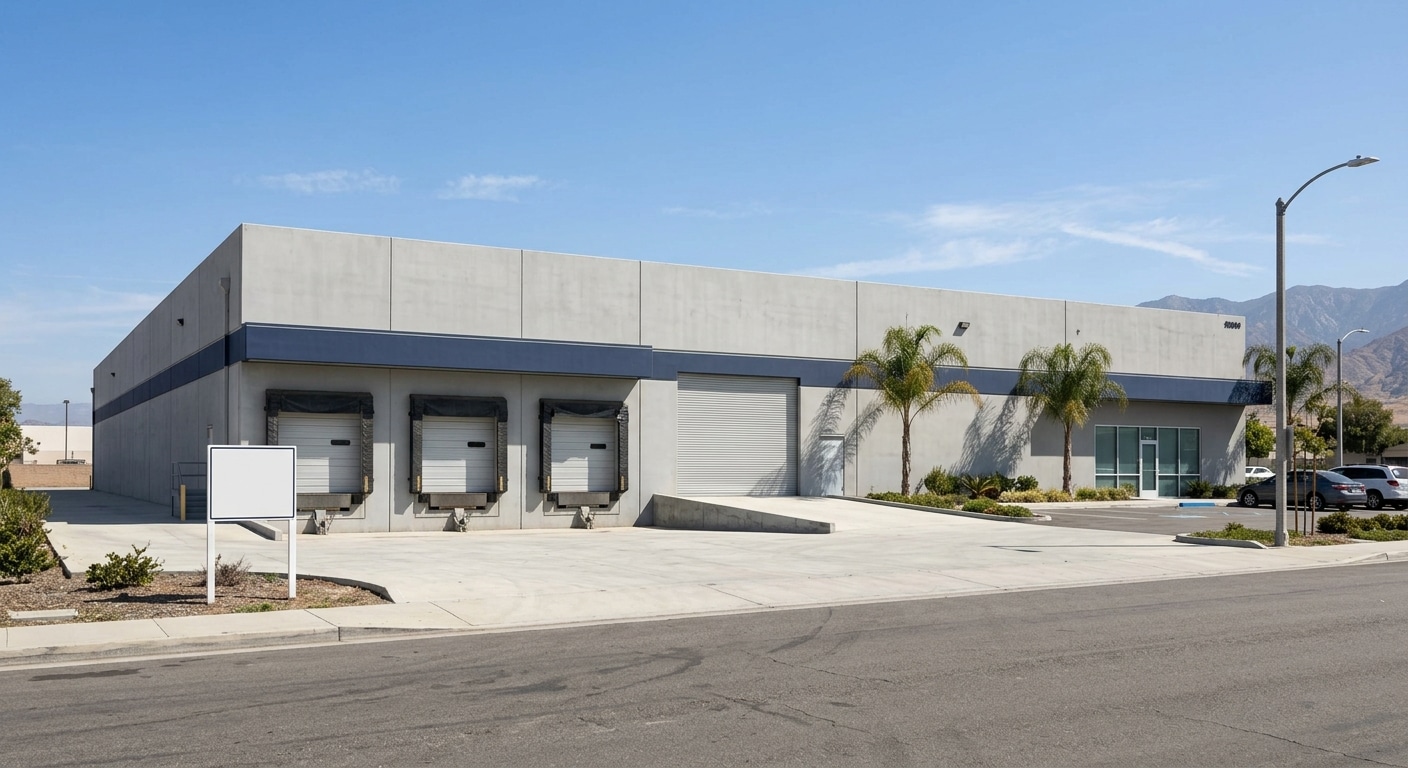
Let’s put real numbers on it. This is a hypothetical, but a realistic one: a 24,000-square-foot small-bay industrial building in Ontario with an all-in project cost of $6.0 million, covering purchase, closing costs and a modest tenant improvement budget. Financed with an Inland Empire SBA 504 loan, that’s $600,000 down. The alternative is leasing a comparable building at $1.10 per square foot per month NNN, a little above the market average because small-bay space runs tighter than big-box, with 3.5% annual increases.

| Lease | SBA 504 purchase | |
|---|---|---|
| Cash needed on day one | Deposit and first month | $600,000 (10%) |
| Year 1 monthly cost | $26,400 rent | $37,644 debt service |
| Year 10 monthly cost | About $35,980 rent | $37,644 (fixed) |
| Total paid over 10 years | About $3.72 million | About $4.52 million |
| Principal paid down by year 10 | $0 | About $1.17 million |
| 10-year cost net of equity built | About $3.72 million | About $3.35 million |
Assumptions: $3.0 million bank first mortgage at 6.75% fixed, 25-year amortization; $2.4 million CDC piece at 6.97%, 25 years. This analysis does not model CDC and SBA fees, appreciation, or tax effects. Both scenarios are NNN, so taxes, insurance, and maintenance are excluded from both columns.
Heres the honest read. Owning costs about $11,000 more per month in year one. That’s real cash, and it has to come out of the business. By year ten, the rent has nearly caught up, and around year eleven the rent passes your fixed payment for good. Over the full ten years, you pay roughly $370,000 less in interest than you would have paid in rent.
But that $600,000 down payment could have earned something else. Park it in Treasuries at 5%, and it grows by roughly $375,000 over the same ten years. So on pure cost, it’s close to a wash. What tips it is everything the table leaves out: appreciation on the building, depreciation on your taxes, and control over your own occupancy cost in a market where rents have swung hard in both directions since 2021.
The same building on a conventional permanent loan at 70% loan-to-value would drop the payment to about $29,400 a month. It would also take $1.8 million down. For most operators, that’s where the conversation ends.
So whether to buy or lease a warehouse in the Inland Empire usually comes down to three questions. Can the business carry the higher payment early without starving working capital? Will you be in the building more than seven to ten years? And do you want a fixed occupancy cost instead of a rent that resets every lease cycle? Yes on all three, and the 504 usually wins. If the business needs that $600,000 for inventory or equipment, keep leasing and look again next year.
IE West vs. IE East for Owner-Users
The Inland Empire isn’t one market, and the 504 math changes depending on which side of the I-15 you’re on.
IE West (Ontario, Chino, Rancho Cucamonga, Fontana, Eastvale) is tighter, at 6.5% vacancy per Colliers and 5.9% per CBRE. You’ll pay more per square foot to buy, but you’re closer to the ports, LA labor and the I-10 and I-15 corridors. Buildings here hold value better in a downturn, which matters when a bank and a CDC are both lending against the same building.
IE East (Riverside, Moreno Valley, Perris, San Bernardino, Redlands, Beaumont) runs looser, at 9.3% vacancy. That means more inventory, softer pricing, and sellers who’ll negotiate. The tradeoff is longer drayage and a thinner pool of future buyers if you ever sell.
One more factor. California’s AB 98 has made new warehouse projects harder to site and entitle near homes and schools. That slows new supply, which tends to support the value of existing, already-entitled buildings. Good news if you’re buying one. If your business runs mostly on yard space with a small office, talk to us early, because occupancy and appraisal get complicated fast on industrial outdoor storage. For more on the region’s lending landscape, see our 2026 Inland Empire commercial real estate loan guide.
Inland Empire SBA 504 Loan Checklist: What Kills Deals
A lot of 504 files die in the first two weeks over things nobody checked. Run through these before you make an offer:
- Owner occupancy. Your business has to occupy at least 51% of an existing building, or 60% of new construction. You can lease the rest to tenants, and that rent helps cover the payment. Planning ground-up construction? The 60% rule applies at completion, with occupancy expected to rise over time.
- Size standards. The business generally needs tangible net worth under $20 million and average net income under $6.5 million after taxes for the prior two years. Some industries qualify under alternative standards.
- Job creation. The standard test is one job created or retained per $90,000 of CDC financing, or $140,000 for manufacturers. Most growing businesses clear it, and public-policy goals can substitute.
- Special-purpose buildings. Highly specialized facilities can be classed as special-purpose, which adds 5% to the down payment. Ask the CDC how they’ll classify yours before you’re in escrow, not after.
- Prepayment premium. The CDC piece carries a premium that declines to zero over the first half of the term, so the first 10 years on a 20- or 25-year loan. The bank piece has its own terms. Negotiate those.
- Timeline. Approval and funding typically take 60 to 90 days. If the seller wants to close in 30, you may need a short-term bridge loan to take the building down first.
- Already own? The 504 refinance program now goes up to 90% loan-to-value. If you’re refinancing an Inland Empire building you already own, it’s worth a look against your maturing loan.
Where a Broker Fits When the CDC Already Does 504s
Fair question. CDCs do 504s all day, and they’re good at it. But a CDC sells one product. It won’t tell you that a bank across town will do a conventional loan at 20% down on your particular building. Or that a 7(a) makes more sense because half your project is equipment and working capital. Or that the bank first mortgage, which is half your financing, is priced 50 basis points above what another lender would quote.
That’s Financial Compound’s job. We represent the borrower, not the lender. On every Inland Empire SBA 504 loan we work, we shop the bank first mortgage as hard as the CDC piece, line up SBA and business-purpose financing alongside conventional options, and put the offers side by side so you see the real cost of capital, not just the rate on the term sheet. Michael has watched alot of owner-users talk themselves out of buying because they compared the wrong two numbers. Our Inland Empire commercial mortgage team works Riverside and San Bernardino County deals every week, and we never charge upfront fees.
Frequently Asked Questions About SBA 504 Industrial Loans
What is the SBA 504 loan rate in October 2026?
The October 8, 2026 debenture sale set the 25-year SBA 504 effective rate at 6.97%, including CDC, SBA and servicing fees. Manufacturers, listed food-supply-chain businesses and rural projects were at 6.74%, and the 10-year rate was 6.59%. Your loan’s rate is set at the debenture sale after closing, not at application.
How much do I need to put down on an Inland Empire SBA 504 loan?
Most owner-users put down 10% of the total project cost. The minimum rises to 15% for a business under two years old or a special-purpose building, and to 20% if both apply. A conventional bank loan on the same building typically requires 25% to 35%.
Can I lease part of the building to a tenant?
Yes. Your business must occupy at least 51% of an existing building, or 60% of new construction. You can lease the remaining space to tenants, and that income can help cover the loan payment.
Is it cheaper to buy or lease a warehouse in the Inland Empire right now?
It depends on how long you’ll stay. In our example of a 24,000-square-foot Ontario building, owning with a 504 cost about $11,000 more per month in year one, but came out roughly even with leasing over ten years before counting appreciation and tax benefits. Owners planning to stay ten years or more generally do better buying.
How long does an SBA 504 loan take to close?
Approval and funding typically take 60 to 90 days. The bank funds the full purchase at closing, and the CDC portion is taken out at the next monthly debenture sale, which is when your fixed rate is set.
What is the maximum SBA 504 loan amount?
The CDC portion is capped at $5 million for most businesses and $5.5 million for manufacturers and certain energy projects. Because the bank provides 50%, a standard 50/40/10 structure covers projects up to about $12.5 million, and larger projects are possible with a bigger bank share.
Talk to Financial Compound About Buying Your Building
If you lease industrial space in the Inland Empire and want to know whether owning pencils for your business, we’ll run the numbers on your actual building against every financing option that fits. Financial Compound has placed over $6 billion in commercial debt and equity since 1996, and we represent borrowers only. Call Michael at (310) 260-5900 x3, email info@commercialmortgagebroker.org, or book a consultation online.