
Everybody wants to know where the pain is. Fair question. Heres the short answer: if you line up the big metros by how much of their commercial mortgage debt is in trouble, two names keep showing up near the top. On the West Coast it’s San Francisco. On the East Coast it’s Philadelphia. Different stories, different property types, same basic problem — debt that was written for a world that doesn’t exist anymore.
Nationally, the CMBS distress rate sat at 11.2% in October 2026, up from 10.9% a year earlier, with office loans at 16.4%, according to CRED iQ’s October metro breakdown. That’s the average. The two markets below are running well above it, and the reasons why tell you a lot about where the opportunities are going to be over the next few years.
How We Picked the Two Most Distressed Markets
We used loan-level CMBS distress — debt that’s 30+ days delinquent, past maturity, or sitting with a special servicer — as the yardstick, because it’s the most consistent apples-to-apples number across metros. Two data sets, same conclusion.
- KBRA, January 2026: San Francisco ranked first among the 20 largest metros at 22.6% distressed. Philadelphia ranked third at 17.2%, and its 34% office distress rate was the worst of any major metro (KBRA’s metro-level report).
- CRED iQ, October 2026: Philadelphia climbed to 23.0% with office distress at 37.4%. San Francisco is still the most distressed big market in California at 17.5%, ahead of Los Angeles at 14.6%.
| Metro | CMBS balance | Distress rate (Oct 2026) | Year ago | Office distress |
|---|---|---|---|---|
| Chicago | $22.1B | 23.5% | 19.5% | 32.6% |
| Philadelphia | $12.0B | 23.0% | 21.3% | 37.4% |
| San Francisco | $23.2B | 17.5% | 19.8% | 5.8% |
| Los Angeles | $33.3B | 14.6% | 9.4% | 21.5% |
| Washington, D.C. | $22.1B | 12.5% | 10.6% | 19.7% |
| New York | $147.0B | 11.2% | 12.5% | 12.7% |
| Boston | $18.3B | 6.2% | 4.2% | 2.7% |
Source: CRED iQ loan-level CMBS data, October 2026. Chicago is the overall leader but isn’t coastal, so it’s outside the scope of this piece.
Notice something weird about San Francisco? Office distress is only 5.8%. That’s not because SF office got healthy overnight. It’s because a lot of the worst office loans already got foreclosed, sold, or handed back. The distress moved into hotels and apartments. More on that below.
The Rate Backdrop Borrowers Are Dealing With (November 2026)
Distress is a debt story, so you gotta start with the cost of money. As of this week:
| Benchmark | Current level | Note |
|---|---|---|
| SOFR | 3.95% | October 30, 2026 print |
| Fed funds target | 3.75%–4.00% | Raised 25 bps on Sept. 16; held Oct. 28 on a 10–2 vote, both dissents wanted a hike |
| Prime rate | 7.00% | Fed funds ceiling + 300 bps |
| 10-Year Treasury | ~4.9% | Near a seven-week low after a tech-stock sell-off |
Sources: New York Fed SOFR data and the Federal Reserve’s H.15 release. Rates move daily — call us for a live quote.
Translation: the rate relief people were banking on in 2025 reversed. The Fed is talking about hiking again, not cutting. A loan written at 3% in 2021 that has to refinance at 6.5% or more today just doesn’t pencil unless the owner writes a big check. That’s the engine behind both of these markets.
San Francisco: California’s Most Distressed Commercial Real Estate Market
Why San Francisco Is Distressed
Office took the first hit — and the losses got crystallized. SF office vacancy peaked around 36.9% in Q3 2024 per CBRE. Buildings that traded for $800 to $1,000 a foot before the pandemic started clearing at a fraction of that. A Mid-Market building, 1128 Market Street, sold out of foreclosure in March 2026 for about $100 per square foot. That’s not a typo. Lenders took the losses, the assets reset, and that’s why office distress in the CMBS data has dropped so sharply.
Hotels are the bigger problem now. KBRA pegged SF lodging distress at 83.2% in January 2026 — the highest of any property type in any major metro. The poster child is Parc 55 and Hilton Union Square. Park Hotels walked away from a $725 million loan in 2023, and the two hotels — almost 10% of the city’s rooms — finally sold for $408 million, down nearly 75% from a 2016 appraisal. The Barnes in Union Square defaulted on a $68 million loan and changed hands in early 2026. Convention and business travel never fully returned.
Multifamily distress is real, and it’s mostly a capital-structure issue. KBRA had SF multifamily at 49.7% distressed. The headline case is Veritas Investments defaulting on $652 million of debt tied to 66 buildings and roughly 1,566 units. Older, rent-controlled buildings bought with cheap floating-rate money got squeezed when rates jumped, and rents can’t reset fast enough to cover the new debt service.
Opportunities in San Francisco
- Office at reset basis, with an AI tailwind. Kidder Mathews puts overall SF office vacancy at 26.0% in Q3 2026, down from 31.1% a year ago, with more than 10 million square feet leased year-to-date (Kidder Mathews Q3 numbers). AI firms are driving most of the absorption. Buying a well-located building at $100–$300 a foot when the replacement cost is many times that — that’s the trade.
- Hotels bought below replacement cost. Almost no new hotel rooms have opened since the pandemic, so supply is frozen. Institutional buyers like Blackstone have already stepped in. Smaller operators can follow with recapitalizations of tired independent hotels.
- Multifamily recaps. SF apartment vacancy is extremely tight — around 2.4% by some measures. Buildings are full; loans are broken. That’s exactly where rescue capital, preferred equity, and a smart refinance can create value.
- Note purchases. Some of the best SF deals in the last two years were people buying the debt, not the building, then taking title.
San Francisco Long-Term Outlook
Michael’s view: SF is past the worst on office and probably closer to the bottom than anybody else on this list. The data says the distress rate is falling — 17.5% vs. 19.8% a year ago. The risk is concentration. The recovery is leaning hard on AI companies, and the late-October tech sell-off reminded us the sector can cool fast. Hotels and older rent-controlled apartments will take another 12 to 24 months to work out. Long term? A cheaper, more residential, more tech-heavy downtown. Not the 2019 city — a different one, and for buyers coming in at today’s basis, maybe a better one.
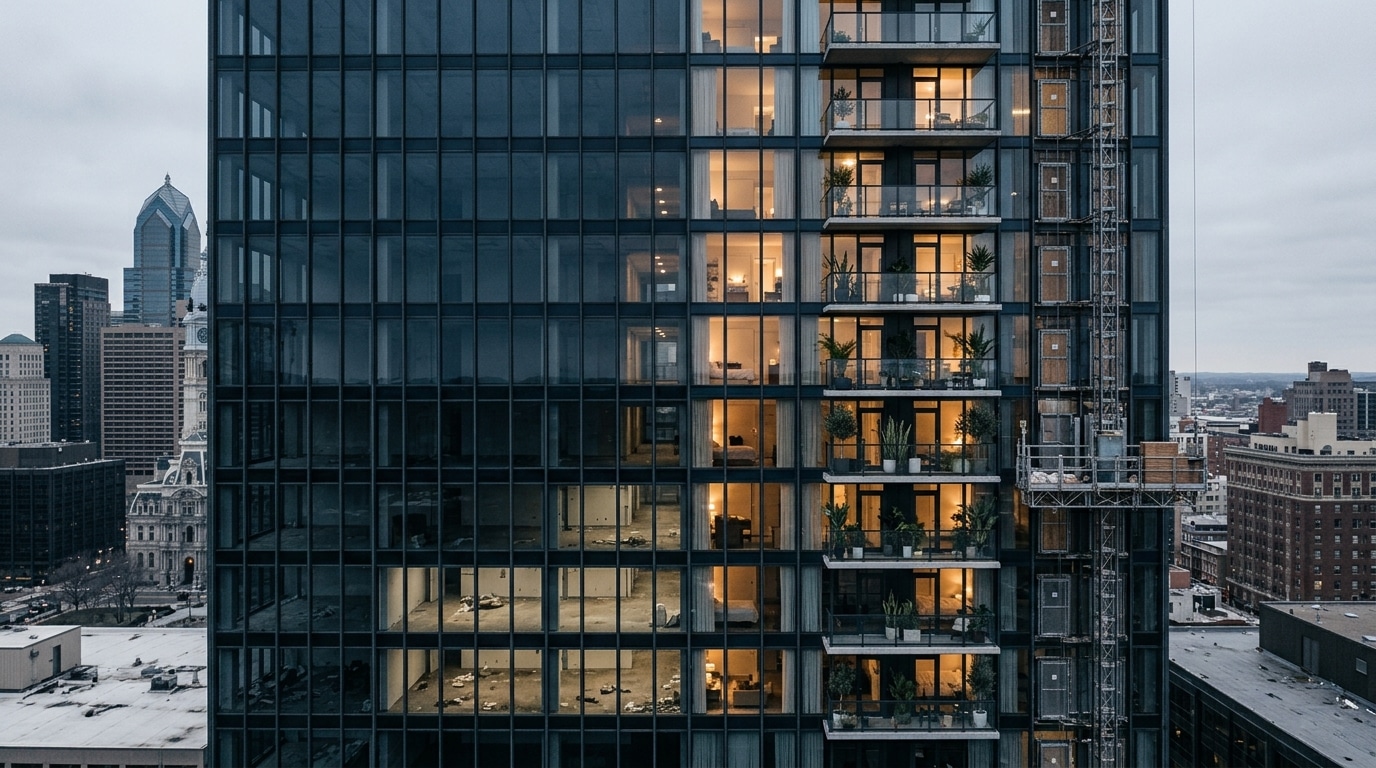
Keep an eye on Los Angeles. LA’s CMBS distress jumped from 9.4% to 14.6% in a year, and office distress more than doubled to 21.5%. Downtown’s Equitable Plaza loan missed its extended October maturity, with the tower last valued at $57.7 million, down from $150.5 million at origination. SF is the worst in California today, but LA is the one moving in the wrong direction. If you own LA office with a 2027 maturity, start planning now.
Philadelphia: The East Coast’s Most Distressed Commercial Real Estate Market
Why Philadelphia Is Distressed
Market Street West is the epicenter. Philly’s distress is unusually concentrated. In August, three loans on Market Street West — 1500, 1700 and 1818 Market — totaled $779 million and made up roughly 40% of the whole metro’s CMBS distress. These are big 1970s-to-1990s towers that lost law firms and corporate tenants to newer buildings.
The price resets are brutal. Center Square at 1500 Market — the city’s largest office complex, 2.2 million square feet across from City Hall — was 36% occupied when it hit the market. A judge approved its sale for $70 million, about 21% of the $328 million it traded for in 2017 (Bisnow’s coverage of the court ruling). Next door, 1818 Market’s appraisal was cut to $158 million in July 2026 against a mortgage of roughly $223 million. The building is in receivership.
Even full buildings can’t refinance. This is what should worry every owner. 2400 Market Street is 99.5% occupied with Aramark leased through 2034, and its $205 million CMBS loan still went to special servicing on September 29 ahead of a December 9 maturity. Occupancy isn’t the issue. The issue is the gap between what the loan is and what a lender will write today at today’s rates and today’s valuations.
The office recovery stalled. CBRE has Greater Philadelphia office vacancy at 22.3% in Q3 2026. Avison Young says conditions softened in the third quarter, with leasing down for the third straight quarter and year-to-date absorption losses past 300,000 square feet. Worker counts in the West Market skyscraper district are still only about 50% to 60% of where they were.
Opportunities in Philadelphia
- Office-to-residential conversions. Philadelphia leads the country in conversion activity. Roughly 2 million square feet of Center City office is slated for conversion, including plans for up to 500 units at Center Square and 273 units at Ten Penn Center. At $40 to $60 a foot for the shell, the math can finally work.
- Apartment demand is there to absorb it. Philly metro multifamily vacancy is 3.4% with a record average rent of $1,969, and Greater Center City absorbed nearly 4,900 units in 18 months (Center City District’s 2026 housing report). Conversions have a real tenant base.
- Industrial is quietly strong. Industrial vacancy tightened to 8.7% in Q3 2026 with record asking rents near $11.94 a foot. Not distressed — but a good place to redeploy capital from a troubled office sale.
- Rescue capital for performing-but-overleveraged assets. Buildings like 2400 Market need a bridge, a pref equity piece, or a negotiated modification — not a fire sale. That’s where a broker earns his fee.
Philadelphia Long-Term Outlook
Philadelphia’s distress is still climbing — 23.0% vs. 21.3% a year ago — so this is earlier in the cycle than San Francisco. Expect more Market West towers to trade at reset prices through 2027. The long-term case is better than the headlines, though. Philly has eds-and-meds employers, a downtown that keeps adding residents, and a city that is actively talking about tweaking its tax abatement to help conversions. Our take: 2026 and 2027 are the clean-up years. Investors who buy obsolete office at land-plus-shell pricing and convert it are setting up for the next decade. Owners holding Class B office with near-term maturities need a plan yesterday.
San Francisco vs. Philadelphia at a Glance
| Factor | San Francisco | Philadelphia |
|---|---|---|
| CMBS distress (Oct 2026) | 17.5%, falling | 23.0%, rising |
| Main distress driver | Hotels and rent-controlled multifamily | Class A/B office on Market Street West |
| Office vacancy (Q3 2026) | 26.0% (Kidder Mathews), improving | 22.3% (CBRE), stalled |
| Signature distressed trade | Parc 55 / Hilton Union Square at $408M, ~75% off 2016 appraisal | Center Square at $70M, ~21% of 2017 price |
| Best opportunity | Reset-basis office, hotel and apartment recaps | Office-to-residential conversions, rescue capital |
| Where it is in the cycle | Late — bottom forming | Middle — more losses ahead |
What This Means If You Own or Want to Buy in a Distressed Market
Heres what we tell clients, whether it’s SF, Philly, or downtown LA. Distress isn’t one thing. A building that’s 40% leased needs a different solution than a building that’s full but overleveraged.
- Maturity coming in 12–18 months? Start the conversation with your servicer now. A loan modification or workout is a lot easier to negotiate before default than after.
- Need time to lease up or convert? Bridge financing from a debt fund can take out a maturing loan and buy you 24–36 months.
- Buying a distressed asset? Line up acquisition debt before you bid. Sellers and receivers favor buyers who can close.
- Converting office to apartments? Construction-to-perm and multifamily take-out financing need to be mapped from day one.
For a deeper look at the West Coast side, see our San Francisco office loan workout guide.
Frequently Asked Questions
What are the most distressed commercial real estate markets in 2026?
Among major coastal metros, San Francisco and Philadelphia stand out. KBRA ranked San Francisco first nationally in January 2026 at 22.6% CMBS distress. By October 2026, CRED iQ had Philadelphia at 23.0% with 37.4% office distress, second only to Chicago, while San Francisco remained California’s most distressed large market at 17.5%.
Why is San Francisco commercial real estate distressed?
Office values collapsed after vacancy peaked near 37% in 2024, hotels never fully recovered from lost convention and business travel, and older rent-controlled apartment portfolios bought with floating-rate debt could not cover higher interest costs. Office distress has since fallen as bad loans were resolved, but hotel and multifamily distress remain high.
Why is Philadelphia’s office market so distressed?
Distress is concentrated in aging Market Street West towers that lost tenants to newer buildings. Valuations have fallen 36% to nearly 80%, and even fully leased buildings like 2400 Market Street are struggling to refinance maturing loans at today’s rates.
Is now a good time to buy distressed commercial real estate?
For well-capitalized buyers, reset pricing creates real opportunity, especially office-to-residential conversions in Philadelphia and reset-basis office, hotels, and apartment recapitalizations in San Francisco. Execution risk is high, so line up financing before bidding.
What can owners do if their commercial loan is maturing in a distressed market?
Owners can negotiate a loan modification or extension with the servicer, refinance with a bridge lender or debt fund, bring in preferred equity or rescue capital, or sell. Starting 12 to 18 months before maturity gives the most options.