
Rates went the wrong way this fall. Many borrowers planned for 2026 around cuts, but the Federal Reserve raised its benchmark on September 16 for the first time since July 2023. The 10-year Treasury, which matters even more for how commercial loans get priced, closed at 5.00% on October 23 after hitting its highest level since 2002 earlier in the month. So if you’re trying to figure out where commercial real estate interest rates are headed and what that does to your property, heres the short version. Higher for longer just got longer.
I have been brokering commercial loans since 1996. Michael has watched a handful of these rate cycles play out, and the mechanics don’t change much. What changes is which property types and which markets take the hit. Below is how today’s rates are affecting commercial real estate across the U.S., and then specifically in California, where the story splits hard by city and by property type.
Commercial Real Estate Interest Rates Right Now: October 2026 Snapshot
These benchmarks drive what lenders quote. We checked every number below against live market data the week of October 19, 2026.
| Benchmark | Current level | What it prices |
|---|---|---|
| Federal funds target range | 3.75%–4.00% (raised Sept. 16, 2026) | Short-term money, and indirectly everything else |
| Prime rate | 7.00% | Bank lines, many bank loans, SBA 7(a) variable loans |
| SOFR (overnight) | About 3.87%–3.90% in October | Bridge loans, debt fund loans, floating-rate CMBS and bank loans |
| 30-day average SOFR | 3.89% (Oct. 22) | Common index on floating commercial loans |
| 10-year Treasury | 5.00% (Oct. 23 close) | Agency, life company and CMBS fixed-rate loans |
| 2-year Treasury | 4.69% (Oct. 23 close) | Market expectations for the Fed over the next two years |
Sources: Federal Reserve, New York Fed SOFR data, Treasury closing yields. Rates change daily.
Heres what got us here. Inflation turned back up in 2026, with September CPI running at 3.7% year over year, and the conflict with Iran pushed oil to roughly $100 a barrel by early October. The Fed, now chaired by Kevin Warsh, raised rates 25 basis points in a unanimous vote, and its projections put the median year-end fed funds rate at 4.1%, implying one more hike. Long-term yields climbed even faster on account of a federal deficit near $2 trillion for fiscal 2026 and heavy bond issuance tied to AI infrastructure. The next two Fed decisions land on October 28 and December 9.
Which Rate Actually Prices Your Loan
This is the part most owners get wrong. The Fed doesn’t set your commercial mortgage rate. For most permanent loans, the lender takes a benchmark index and adds a spread. Which index depends on the loan type.
| Loan type | Index | Indicative rate range (Oct. 22, 2026) |
|---|---|---|
| Freddie Mac 10-year fixed multifamily (55%–80% LTV) | 10-year Treasury | 6.03%–6.43% |
| Fannie Mae 10-year fixed multifamily (55%–80% LTV) | 10-year Treasury | 6.13%–6.73% |
| Life insurance company, commercial 10-year | 10-year Treasury | 6.48%–7.28% |
| CMBS 10-year (65%–75% LTV) | 10-year Treasury/swaps | 6.83%–7.33% |
| Bank and SBA 7(a) variable | Prime (7.00%) | Prime plus a margin |
| Bridge and debt fund loans | SOFR (about 3.89%) | SOFR plus a spread, usually with a floor |
Fixed-rate ranges are indicative market quotes published October 22, 2026, not loan commitments. Your rate depends on property, sponsor, leverage, and term.
Notice something odd in that table. SOFR is sitting roughly 110 basis points below the 10-year Treasury. The yield curve has steepened, so floating-rate debt is cheaper on the index than fixed-rate debt right now. Thats not a free lunch though. The Fed is in a hiking cycle, and a floating loan absorbs every hike the day it happens. That’s why rate caps and hedging costs belong in any floating-rate decision this year.
How Interest Rates Affect Commercial Real Estate Values
Rates hit property values through cap rates. When a buyer can earn 5% on a risk-free Treasury, they demand more than that to own a building with tenants, roofs, and vacancies. So cap rates rise, and at the same net operating income, a higher cap rate means a lower value.
We have already seen this play out. First American estimated all-property cap rates at roughly 6.3% in the first quarter of 2026, up from about 5.2% in late 2021. And CRED iQ found that on loans securitized earlier in 2026, the average cap rate on the collateral sat almost right on top of the average mortgage coupon. In plain English, the typical 2026 borrower was getting zero positive leverage, and that was before the 10-year jumped toward 5%.
That’s the real story for 2026. When your borrowing cost is at or above your cap rate, leverage stops boosting returns. Buyers either need rent growth, a value-add plan, or more equity. Sellers who need 2021 pricing mostly aren’t getting it.
The Refinance Squeeze: Same Building, Smaller Loan
Most lenders size loans on debt service coverage. Higher rates mean a bigger payment on every dollar borrowed, so the same income supports a smaller loan. Heres a simple example using a property with $1,000,000 in NOI, a 1.25x DSCR requirement, and 30-year amortization.
| Interest rate | Maximum loan supported | Change vs. 4.50% |
|---|---|---|
| 4.50% (typical 2021 agency loan) | About $13.16 million | — |
| 6.30% (mid-range agency today) | About $10.77 million | About 18% less |
| 7.00% (CMBS or bank range today) | About $10.02 million | About 24% less |
Illustration only. Actual sizing also depends on LTV limits, debt yield tests, and lender underwriting.
That gap is the whole problem. An owner who borrowed $12 million in 2021 on that building can’t refinance it in full today without bringing cash to the table, even if the property is performing fine. That’s where bridge loans, preferred equity, mezzanine debt, and loan modifications come in.
Maturities, Delinquencies and Where the Stress Shows Up
The Mortgage Bankers Association estimates that $875 billion of commercial and multifamily mortgages, about 17% of the $5.0 trillion outstanding, are scheduled to mature in 2026, with another $652 billion due in 2027. The good news is that’s down from 2025. The bad news is lenders have gotten much less willing to extend, so more of these loans have to be resolved through a refinance, sale, workout, or default.
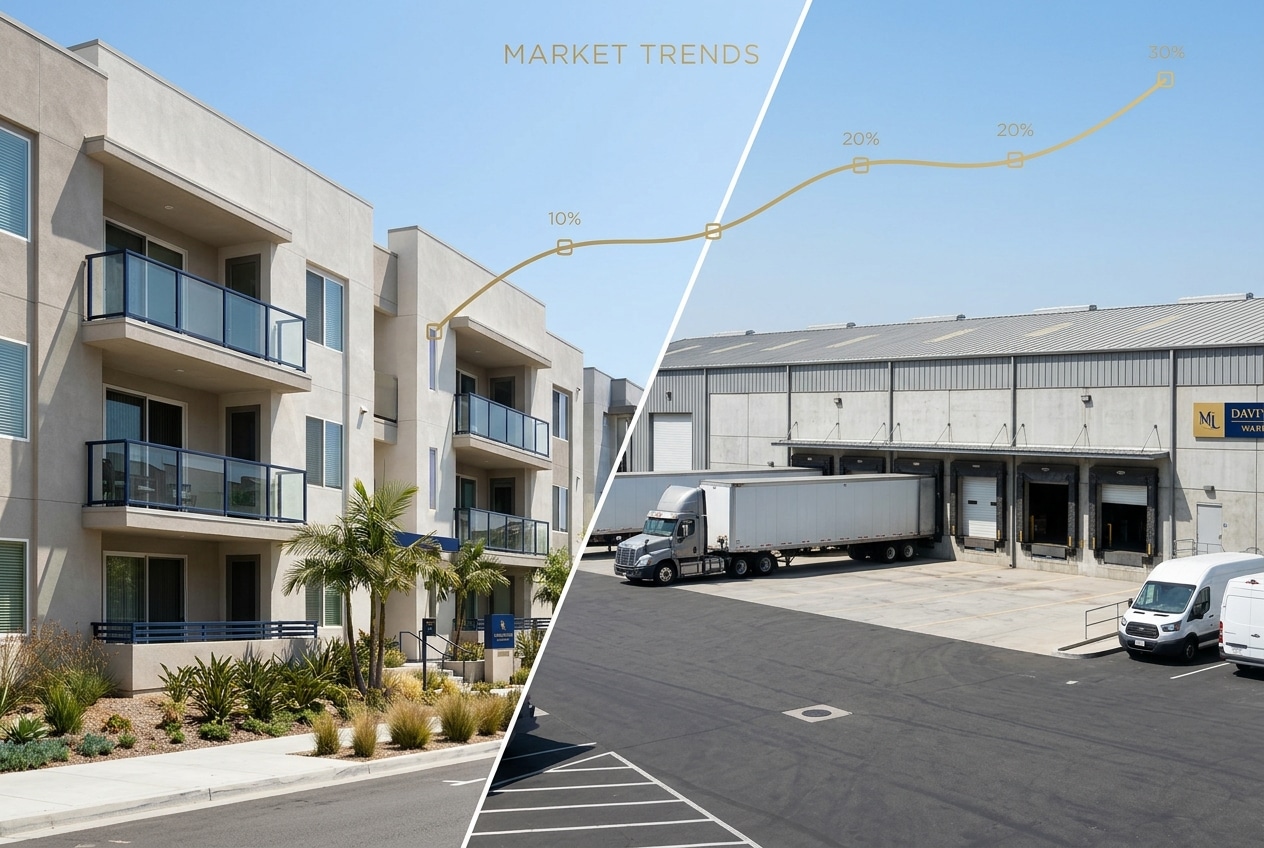
The CMBS market shows where the pain is. Trepp reported the overall CMBS delinquency rate climbed to 8.02% in September 2026, the highest since late 2020. Office delinquency is above 12%. Multifamily delinquency rose to 8.04%, up from 6.59% a year earlier, suggesting floating-rate apartment loans written at the peak are still working through the system. Industrial is the standout at just 1.14%.
What Is Different About California
California borrowers pay the same Treasury and SOFR as everyone else. What changes is the starting point. Coastal California has historically traded at some of the lowest cap rates in the country, so the gap between cap rates and borrowing costs is tighter here than in most of the nation. Add local transfer taxes, slow entitlement and big swings between submarkets, and higher rates hit California deals differently.
The Summer 2026 Allen Matkins/UCLA Anderson Forecast survey of California developers found the market stabilizing rather than recovering, with developers largely accepting that rates will stay elevated. Industrial and multifamily drew the most optimism, office the least. Among respondents, 75% in Northern California and 64% in Southern California expect multifamily demand to outpace supply over the next three years. Thats a big deal for apartment owners, because rent growth is the main way out of a negative leverage position.
Los Angeles: Office Pain Plus the Measure ULA Factor
Kidder Mathews put Los Angeles office direct vacancy at 16.4% in the third quarter of 2026, with total vacancy including sublease at 17.7%. Downtown is much weaker, with direct vacancy above 23%. Office loans are the hardest to refinance in the city right now, and lenders are pricing them accordingly.
Then there’s Measure ULA. For City of Los Angeles transfers closing after June 30, 2026, deals from about $5.4 million to $10.9 million carry a 4% ULA tax and deals at $10.9 million and up carry 5.5%, on top of the regular transfer taxes. It applies to apartments, retail, industrial, and office, not just mansions. In July, the City Council shelved a ballot proposal to exempt new apartment construction, though it approved a tax credit that lets qualifying projects with affordable units and prevailing-wage labor reduce the rate. Studies cited by RAND found high-value sales dropped sharply after ULA took effect.
Put ULA together with 6%-plus debt, and the math pushes many LA owners to refinance and hold rather than sell. That makes refinance execution, not sale pricing, the key number for many LA properties. One note for our neighbors: ULA applies only inside the City of Los Angeles, not in separate cities like Santa Monica or Beverly Hills. See our Los Angeles commercial lending page for how we structure LA deals.
San Francisco and the Bay Area: AI Leasing vs. High Rates
San Francisco is the one office market in California with real momentum. Savills reported 3.9 million square feet of office leasing in Q3 2026, up about 77% from a year earlier, and 12.1 million square feet year to date, putting the city on pace for one of its strongest leasing years in decades. AI companies are driving it. CBRE showed vacancy falling to roughly 29.7% in Q2 from 34.7% a year earlier.
But improving leasing doesn’t fix the capital stack overnight. Office loans that got securitized in 2026 came in at very conservative leverage, around 55% loan-to-value according to CRED iQ, and office spreads still run well above multifamily. So Bay Area office owners with maturing debt usually need a bridge loan, a paydown, or rescue capital to get to the other side of the lease-up. Michael sees more opportunity here than a year ago, but it’s a lender-by-lender market. More on financing in our Bay Area commercial lending page.
Inland Empire: Industrial Softening Meets Higher Debt Costs
The Inland Empire remains the strongest industrial region in the state long term, but Q3 2026 was soft. Vacancy ranged from about 7.3% (CBRE, IE Core) to 9.9% (Savills, full market), depending on the methodology, and Savills recorded roughly 894,000 square feet of negative absorption. CBRE showed IE Core rents down about 3.8% from the prior quarter to around $1.01 per square foot NNN.
Flat rents plus higher rates mean owners refinancing 2021 and 2022 vintage industrial loans face the same proceeds gap described above. Owner-users have a better option. SBA 504 financing offers long-term fixed rates and low down payments, which takes a lot of the rate risk off the table. See our Inland Empire commercial lending page.
California Multifamily: Agency Money Is Still the Cheapest Long-Term Debt
For stabilized apartments anywhere in the state, Fannie Mae and Freddie Mac remain the lowest-cost long-term option, with 10-year fixed quotes in the low-to-mid 6% range in late October. The FHFA raised each agency’s 2026 multifamily lending cap to $88 billion, so capacity isn’t the issue. Proceeds are. California apartment owners with low cap rates often hit the DSCR limit before the LTV limit, which means a smaller loan than they expected. For properties still leasing up or getting renovated, a bridge loan into agency financing is the standard play. Our multifamily loan programs cover the full menu, and we also arrange financing in San Diego.
What California Borrowers Should Do Now
- Stop underwriting rate cuts. The Fed’s own median projection has rates higher at year-end, and several big-bank forecasts see the 10-year near 5% at the end of 2026. Plan with today’s numbers.
- Time your rate lock around Fed meetings. The 10-year moved more than 30 basis points in a few weeks this month. With decisions on October 28 and December 9, lock strategy matters.
- Price fixed against floating honestly. Floating is cheaper on the index today, but you carry every future hike. Get a rate cap quote before you choose floating.
- Start maturities 9 to 12 months early. If your loan comes due in 2027, the time to work it is now. That’s when you still have options like a refinance, a bridge loan, or a loan modification instead of a forced sale.
- Shop every capital source. In this market, the spread between the best and worst quote on the same deal can be more than a full point. Agencies, life companies, CMBS, banks, credit unions and debt funds all price risk differently.
For the official numbers behind this post, see the Federal Reserve’s H.15 selected interest rates release, the Fed’s September 16, 2026 policy statement and the MBA’s 2026 loan maturity survey.
Frequently Asked Questions
How do interest rates affect commercial real estate values?
Higher rates push cap rates up because investors demand more return than they can get from Treasuries. At the same net operating income, a higher cap rate means a lower value. Higher rates also shrink the loan a property can support, which lowers what buyers can pay.
What are commercial mortgage rates in October 2026?
As of October 22, 2026, indicative 10-year fixed quotes ran about 6.03%–6.73% for Fannie Mae and Freddie Mac multifamily loans, 6.48%–7.28% for life company commercial loans and 6.83%–7.33% for CMBS. Bank loans tied to prime start at 7.00% plus a margin.
Did the Federal Reserve raise rates in 2026?
Yes. On September 16, 2026, the Fed raised the federal funds target range by 25 basis points to 3.75%–4.00%, its first hike since July 2023. The next decisions are October 28 and December 9, 2026.
Does SOFR or the 10-year Treasury matter more for my loan?
It depends on the loan. Fixed-rate agency, life company, and CMBS loans are priced off the 10-year Treasury, which closed at 5.00% on October 23, 2026. Bridge loans, debt fund loans and most floating-rate loans are priced off SOFR, which has been running near 3.89%.
How are higher rates affecting California commercial real estate?
California cap rates started lower than most of the country, so higher borrowing costs create negative leverage faster here. Los Angeles office and downtown properties face the most refinance stress, San Francisco office leasing is improving on AI demand, Inland Empire industrial is softening, and multifamily owners mostly face smaller loan proceeds rather than a lack of lenders.
Does Measure ULA apply in Santa Monica?
No. Measure ULA applies to transfers inside the City of Los Angeles only. Separate cities such as Santa Monica and Beverly Hills are not subject to it, though they have their own transfer tax rules.
Should I refinance now or wait for lower rates?
If your loan matures in the next 12 to 18 months, waiting is a bet that the Fed and the bond market will turn quickly, and the Fed’s current projections dont support that. Most borrowers are better off securing financing now with flexible prepayment terms so they can refinance again if rates fall.